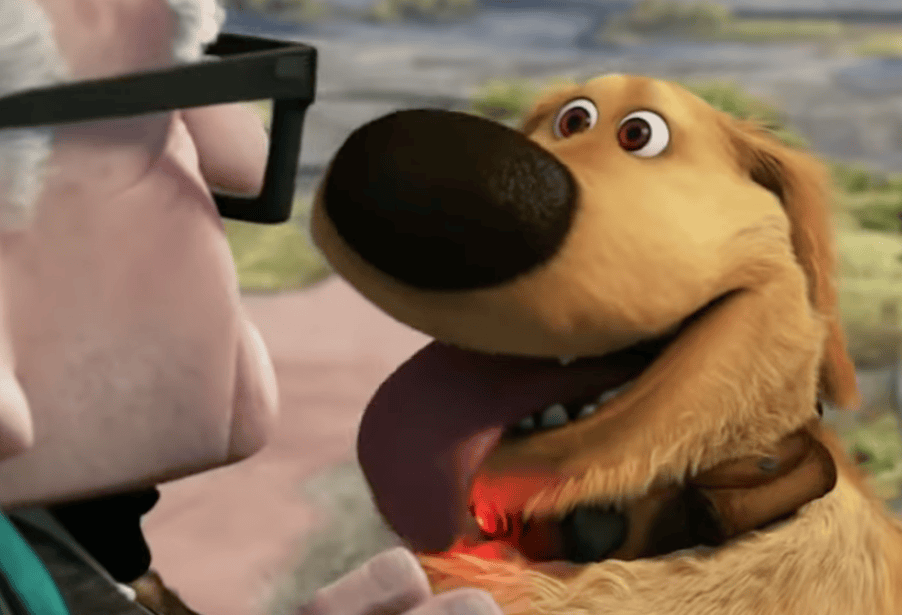
Pixar’s UP (2009)” Doug the talking dog
“Hi there. My name is Doug. I have just met you and I love you. My master made me this collar. He is a good and smart master and he made me this collar so that I may talk – SQUIRREL!!” – Doug.
If only dogs can tell us what they need. They sure are awfully good at licking feet and are always down for walks. Half of the time I’m trying to figure out what my own dog, Gromit, wants from me.
I took Gromit to a socializing training class last month due to his reactive behavior around other dogs. I figured Brent, an experienced K9 dog trainer, who used to train Gromit a few times when I first adopted him, would be able to fix his regressed behavior and get him back on track. We went straight to the socialization part with other dog owners right away.
Leashes were let go as the dogs were monitored to wander around in the confined space while learning to sniff each other’s rear. Corrections were made to ensure no face to face encounter and praises were given after every single time a rear sniff occurs.
After 30 minutes of meet and greet with other dogs, I came up to Brent and asked, “So Brent, you’re telling me butt first, no face?”
“That’s right. Butt sniff. No face, “ replied Brent.
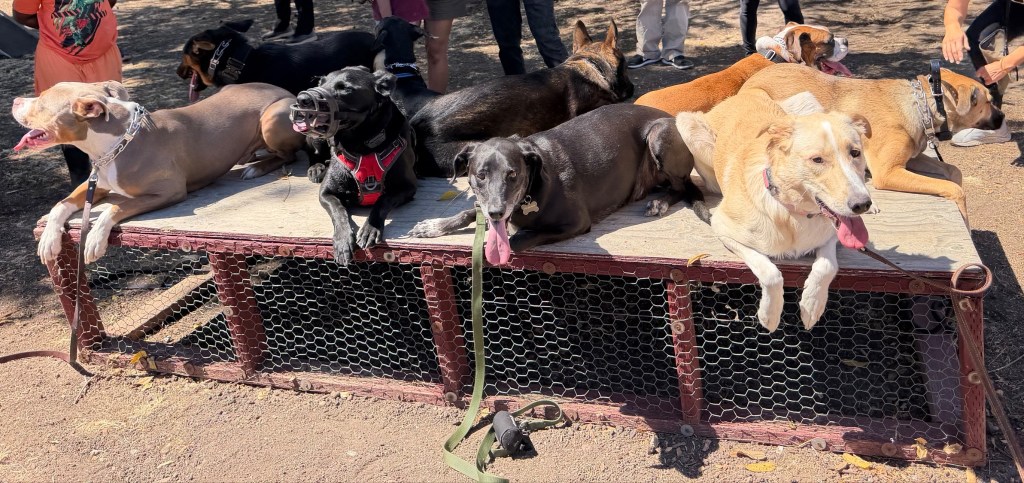
Gromit during training (green leash). No dogs were harmed in the training of this lesson.
Why all the rear end sniffing? Based on this article by the American Chemical Society, it is a way for dogs to communicate with each other. Instead of communicating verbally like Doug, our dogs communicate through chemical scent. Dogs gather information from each others’ rear ends such as their emotional state, their state of health, their gender, and what they even had for dinner. By avoiding each dog from interacting face to face to another, it reduces aggression and reactivity among them.
Gromit was guided gently to sniff other dogs’ rear, so I positively praised him. He sniffed another dog’s rear, and I praised him some more. It got to the point where he started sniffing rears so much, he exhausted himself and I was exhausted from excessively giving him praises that we both just stood there in the afternoon heat together. The caudate nucleus, a region in the brain and part of the basal ganglia, has a very important role to play in the social rewards and positive learning, that of which is responsible for good emotions (happy face from me), process rewards (verbal support and tummy rubs) and learning and memory (butt sniff is a good behavior).
So in theory, a correct behavior warrants good praises; whereas face to face is a behavior we wanted to avoid, and hence not rewarded. Interestingly, a study by fMRI on 15 awake dogs showed that their ventral caudate, also part of the basal ganglia, lit up a bit more, or become activated, to praises over food. Hence Gromit’s brain is responsive to praises, and positive praises lead to healthy behaviors for the long haul. It’s a win-win for both parties. Good boy! Now let’s go for a walk.
Reference
Cook PF, Prichard A, Spivak M, Berns GS. Awake canine fMRI predicts dogs’ preference for praise vs food. Soc Cogn Affect Neurosci. 2016 Dec;11(12):1853-1862. doi: 10.1093/scan/nsw102. Epub 2016 Aug 12. PMID: 27521302; PMCID: PMC5141954.


Leave a comment